

Understanding Partial Hospitalization Programs: A Bridge Between Inpatient and Outpatient Care
A partial hospitalization program (PHP) is a structured mental health and addiction treatment program that provides intensive care during the day while you return home each evening. It serves as a vital bridge between 24/7 inpatient hospitalization and traditional weekly outpatient therapy.
Quick Overview of Partial Hospitalization Programs:
- Time Commitment: 5-6 hours per day, Monday through Friday
- Living Situation: Live at home and commute to the facility
- Treatment Intensity: More intensive than outpatient, less restrictive than inpatient
- Typical Duration: 2-4 weeks
- Best For: Individuals needing structured support without 24/7 supervision
- What’s Included: Group and individual therapy, medication management, skills training
When full-time inpatient care feels too disruptive and weekly therapy isn’t enough, a partial hospitalization program offers the perfect middle ground. Research shows that PHPs can provide care that is equivalent or even superior to inpatient treatment, often with greater patient satisfaction.
The unique structure of a PHP allows you to learn new coping skills during the day and immediately apply them in your real-world environment each evening. This cycle of learning and application reinforces change and helps you build a strong foundation for recovery.
Whether you are stepping down from inpatient care, trying to avoid hospitalization, or need more structure than weekly therapy, a PHP provides the medical oversight and structured support necessary for healing while keeping you connected to your home and community.
What is a Partial Hospitalization Program (PHP)?
A partial hospitalization program provides the same level of intensive, structured treatment you would receive in a hospital, but with a key difference: you go home at the end of the day. You attend treatment for 5-6 hours daily, five days a week, allowing you to get serious help without completely disconnecting from your family, job, and life.
One of the primary functions of a PHP is crisis stabilization. When symptoms of depression, anxiety, or substance use become acute, a PHP offers immediate, intensive support to help you regain stability, often serving as an effective alternative to full hospitalization.
The program’s design allows you to learn coping skills and immediately test them in the real world. You can practice managing triggers at home or work stress, then return the next day to discuss your experiences with your therapy team. This real-time application makes recovery skills stick.

At its core, a PHP is built on recovery-oriented care, meaning we focus on helping you build a life worth living, not just treating symptoms. You are an active participant in your treatment, setting goals and making decisions about your care. This approach, guided by standards from organizations like the Association for Ambulatory Behavioral Healthcare, empowers you to take control of your recovery.
The Core Goals of a PHP
Everything in a PHP is designed to help you reclaim your life. Key goals include:
- Restoring Function: Rebuilding the skills needed for daily life, such as managing a schedule, meeting responsibilities, and maintaining healthy relationships.
- Preventing Relapse: Identifying personal triggers and developing strategies to handle high-risk situations for both substance use and mental health episodes.
- Improving Coping Skills: Learning practical tools to manage stress, difficult emotions, and challenging situations in healthy ways.
- Ameliorating Acute Symptoms: Stabilizing the intense symptoms that brought you to treatment, allowing you to engage fully in your recovery.
- Building Community Ties: Strengthening connections with family, friends, and community, which serve as your long-term support system. You can also find ongoing support through our Addiction Therapy Kentucky services.
Key Components of Recovery
Effective recovery requires a multifaceted approach. Key components of our PHP include:
- Individualized Treatment Plans: Your care is custom to your unique challenges, goals, and life circumstances based on a thorough initial assessment.
- Interdisciplinary Team: You’ll work with a team of psychiatrists, therapists, and social workers who collaborate on your care.
- Evidence-Based Therapies: We use proven methods like Cognitive Behavioral Therapy (CBT) and Dialectical Behavior Therapy (DBT) to provide you with practical tools for change.
- Psychoeducation: We help you understand your condition, its triggers, and how treatment works, empowering you to make informed choices.
- Peer Support: The group setting provides a powerful sense of community, reminding you that you are not alone in your struggles.
Who is PHP For and What Does It Treat?
A partial hospitalization program is designed for individuals who need more support than weekly therapy but do not require 24/7 supervision. It’s an ideal fit when you need a structured environment to focus on healing but have a stable and supportive home life to return to each evening.

PHP is often used as a step-down approach for those transitioning from inpatient or residential treatment, providing a safety net during a vulnerable period. It’s also an effective way to prevent hospitalization when symptoms become acute but you are not in immediate danger of harming yourself or others.
Conditions Treated in a Partial Hospitalization Program
Our PHPs address a wide spectrum of mental health and addiction challenges. We treat both conditions simultaneously, as addressing only one rarely leads to lasting recovery. Conditions that respond well to PHP include:
- Substance Use Disorders: Providing daily structure and accountability for alcohol, opioid, and other drug addictions.
- Co-occurring Disorders: Integrated treatment for those facing both substance use and mental health challenges. Our Womens Trauma Treatment services offer specialized care in this area.
- Depression and Bipolar Disorder: Intensive support for mood disorders that disrupt daily life.
- Anxiety Disorders: Helping you break free from cycles of fear and worry.
- Trauma and PTSD: Creating a safe space to heal from painful past experiences.
- Other Serious Psychological Issues: Including certain eating disorders and schizophrenia where intensive day treatment is beneficial.
Who is a Good Candidate for PHP?
You might be a good fit for a PHP if you meet the following criteria:
- You are experiencing difficulty with daily functioning, such as at work, in relationships, or with self-care.
- You have tried traditional outpatient therapy, but it has not been intensive enough to produce the desired progress.
- You are motivated for group therapy and willing to participate in a structured, therapeutic community.
- You have a stable housing environment that is safe and supportive of your recovery.
- You are stepping down from residential care and need a bridge to less intensive treatment. Our Residential Treatment Kentucky Ultimate Guide services explain how these levels of care work together.
- You are trying to avoid inpatient hospitalization and can remain safe outside of program hours.
A Day in the Life: The PHP Experience
Imagine redirecting your daily energy toward your own healing. That’s the essence of a day in a partial hospitalization program. You arrive each morning for a full day of structured therapeutic activities and return home in the evening to practice what you’ve learned.
At ARIA Kentucky, our adult PHPs run Monday through Friday for five to six hours daily. This consistent structure is a powerful investment in your recovery, helping you build momentum and create lasting change in a way that less frequent therapy cannot.

What Does a Typical Day in a Partial Hospitalization Program Involve?
Each day in our PHP follows a structured rhythm designed for healing. While your schedule will be custom to your needs, a typical day includes:
- Morning Check-in: A group meeting to share your current state and set intentions for the day.
- Group Therapy Sessions: The core of PHP, where you’ll engage in discussions on managing emotions, handling triggers, and building healthy relationships. You’ll learn from therapists and peers who understand your journey. Learn more at our Group Therapy Program KY services.
- Individual Counseling: One-on-one sessions with your primary therapist to explore personal issues in a private setting.
- Skills-Building Workshops: Practical training on topics like anger management, communication, and relapse prevention.
- Medication Management: Our psychiatric team assesses your needs, adjusts medications, and helps you understand their role in your recovery.
- Psychoeducation: Sessions that explain the science behind your condition, reducing fear and empowering you to take control.
- Experiential Therapies: Activities like art therapy or mindfulness exercises that offer new ways to express yourself and heal.
Therapeutic Modalities and Program Length
We use a combination of proven, evidence-based therapies to create a personalized treatment experience.
- Cognitive Behavioral Therapy (CBT): This cornerstone therapy helps you identify, challenge, and replace negative thought patterns that drive unhealthy behaviors. Explore our Cognitive Behavioral Therapy Program services for more details.
- Dialectical Behavior Therapy (DBT): DBT teaches practical skills in mindfulness, distress tolerance, emotion regulation, and interpersonal effectiveness, which are especially helpful for managing intense emotions.
- Acceptance and Commitment Therapy (ACT): ACT teaches you to accept difficult thoughts and feelings while committing to actions that align with your values.
Most people spend two to four weeks in our partial hospitalization program. However, the length of your stay is based on your progress, not a fixed timeline. Our goal is to provide the support you need for as long as you need it, ensuring you are ready to confidently transition to the next level of care, such as an Intensive Outpatient Program (IOP).
PHP vs. Other Levels of Care
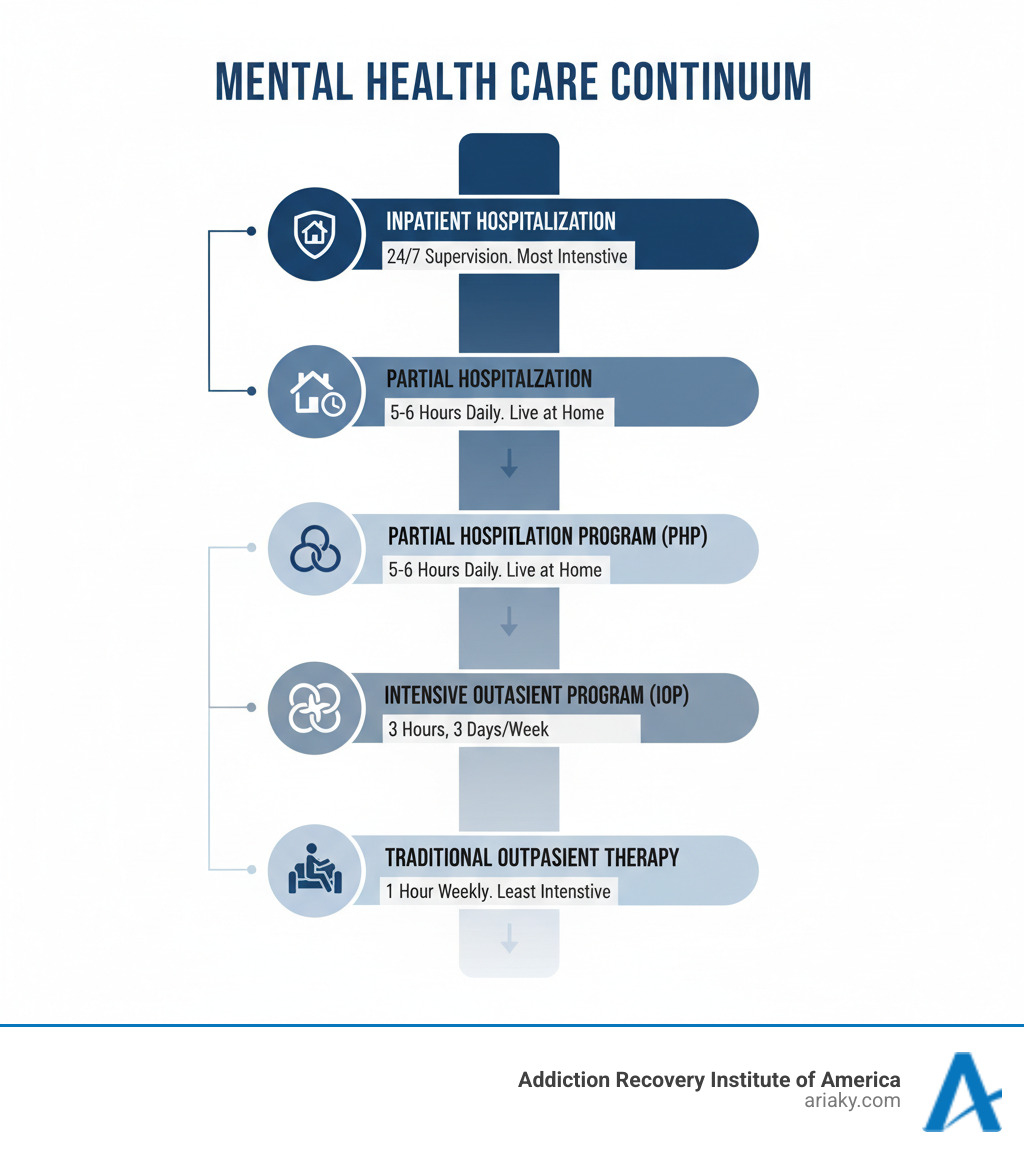
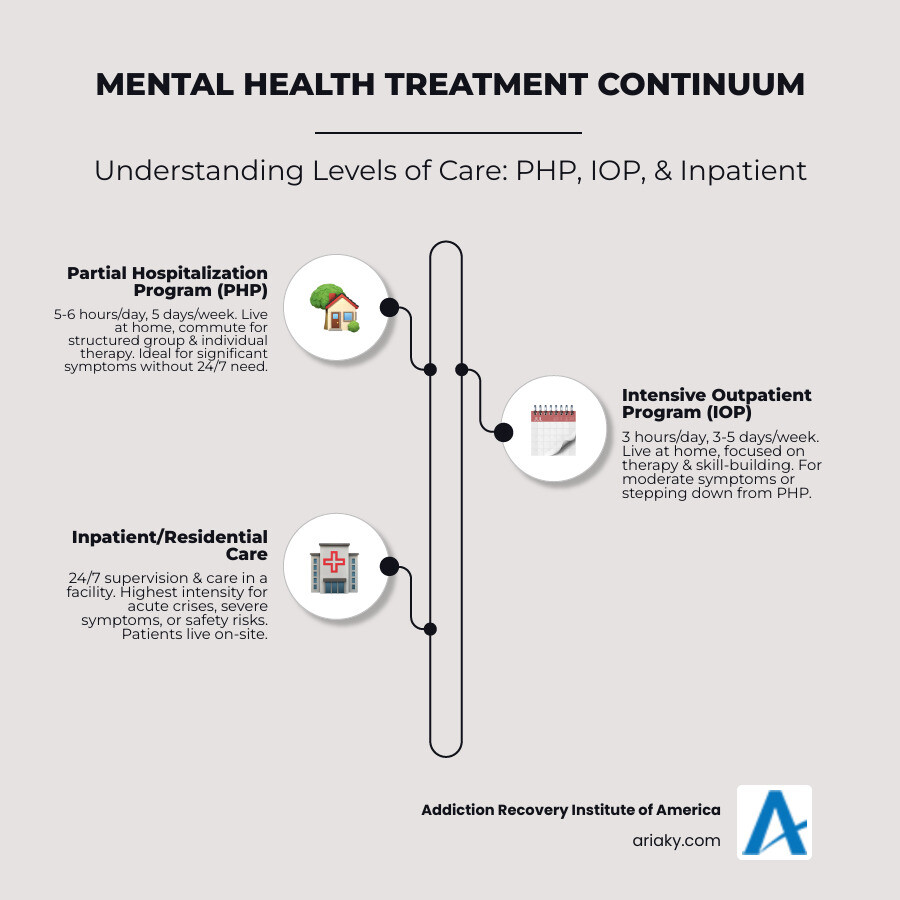
Choosing the right treatment can be confusing. The mental health care system offers a spectrum of support, from 24/7 inpatient care to weekly outpatient therapy. A partial hospitalization program occupies the crucial middle ground, offering intensive day treatment while allowing you to live at home.
Your ideal level of care depends on symptom severity, safety risks, and your home environment. We work with you to determine the best fit for your recovery. To understand the different options, explore our resources on Inpatient vs Outpatient services.
| Feature | Partial Hospitalization Program (PHP) | Intensive Outpatient Program (IOP) | Inpatient/Residential Care |
|---|---|---|---|
| Hours per Day | 5-6 hours | 3 hours | 24 hours |
| Days per Week | 5 days (typically Mon-Fri) | 3-5 days (often Mon, Wed, Fri) | 7 days |
| Living Arranged | At home, commute to treatment | At home, commute to treatment | At facility (24/7 supervision) |
| Ideal Candidate | Acute symptoms, not suicidal/homicidal, stable home, stepping down from inpatient | Moderate symptoms, stable home, balancing treatment with life, stepping down from PHP | Severe symptoms, high risk of harm, unstable home, needs 24/7 supervision |
| Intensity | High | Moderate | Very High |
PHP vs. Intensive Outpatient Program (IOP)
The main difference between partial hospitalization programs and Intensive Outpatient Programs (IOPs) is the time commitment and level of structure. A PHP requires about 5-6 hours a day, 5 days a week, providing a highly structured environment for those with acute symptoms. An IOP is less intensive, typically involving 3 hours a day for 3-5 days a week, offering more flexibility to balance treatment with work or family.
IOPs often serve as the next step after PHP. As you stabilize and gain confidence, you can transition to the less intensive IOP schedule, which usually lasts about six weeks. This step-down process allows you to gradually reintegrate into daily life with continued support. Learn more about our Best Intensive Outpatient Program Kentucky services.
PHP vs. Inpatient Hospitalization
The choice between PHP and inpatient care hinges on one question: Do you need 24/7 supervision to stay safe?
Inpatient hospitalization provides round-the-clock care in a facility and is necessary during acute crises, such as when a person is an immediate danger to themselves or others. A PHP offers the same clinical intensity during the day but allows you to return home at night.
This difference in living arrangements promotes patient autonomy and responsibility. By practicing skills in your real-world environment each evening, you build confidence in managing your condition within your life, not just in a controlled setting. PHPs are also more cost-effective than inpatient care and have been shown to produce equivalent or superior outcomes with higher patient satisfaction. If you can remain safe at home, a PHP is an excellent alternative to hospitalization. For more on residential options, see our Residential Care Kentucky services.
Navigating PHP: From Admission to Aftercare
Starting a partial hospitalization program is a major step, and we are here to guide you through the entire process. From your first call to your aftercare plan, our goal is to make your journey to recovery as clear and supportive as possible.
Your path begins with an assessment, moves into the intensive treatment phase, and concludes with a carefully designed aftercare plan to ensure you have the resources for lasting success.

How to Access and Pay for a PHP
Getting into a PHP is more straightforward than you might think. Referral sources can include your current therapist, an emergency department, or a step-down from inpatient care. Importantly, you can also refer yourself. If you believe this level of care is right for you, you can contact ARIA Kentucky directly for an assessment.
The process starts with a comprehensive initial assessment where our clinical team talks with you to understand your symptoms, history, and current situation. This conversation helps us confirm that PHP is the right level of care for you.
We understand that paying for treatment is a major concern. Most partial hospitalization programs are covered by private insurance, Medicare, and Medicaid, as they are considered a medically necessary service. Our admissions team will work with your insurance provider to verify your benefits and obtain any pre-authorizations. We handle the administrative details so you can focus on your recovery. For more information, visit our Paying for Treatment services page.
Discharge and Continuing Care
Completing a PHP is a significant achievement, but it’s a milestone, not the finish line. Your recovery journey continues with a strong aftercare plan.
Aftercare planning begins long before your last day. Your clinician will work with you to create a personalized plan, which may include stepping down to an Intensive Outpatient Program (IOP), transitioning to weekly therapy, or connecting with community support groups.
We ensure a smooth transition of care by coordinating with your next providers to prevent any gaps in support. The relapse prevention strategies you learn in PHP will be a core part of your aftercare plan, giving you the tools to manage triggers and cravings.
We also connect you with community resources like peer recovery programs and vocational services to help you build a meaningful life that supports long-term sobriety. Many clients stay connected through our alumni programs, which offer a powerful sense of community. To learn how all these levels of care work together, visit our Continuum of Care services page. We are invested in your long-term success and will ensure you have the support you need to thrive.
Conclusion
When facing a mental health or addiction crisis, a partial hospitalization program offers a unique and powerful solution. It bridges the gap between intensive inpatient care and less frequent outpatient therapy, providing the structured treatment you need during the day while allowing you to return home each night.
This approach is not just convenient—it’s transformative. By practicing new skills in your real-world environment daily, you build a durable foundation for recovery. PHPs have proven to be a highly effective, empowering, and cost-effective alternative to traditional hospitalization for many individuals.
At the Addiction Recovery Institute of America (ARIA Kentucky), our PHPs are built on evidence-based therapies delivered by a compassionate team dedicated to your success. If you’re wondering if a partial hospitalization program is the right choice for you or a loved one, we are here to help.
Recovery is possible, and you don’t have to do it alone. For more information about our programs in Kentucky, please visit our Kentucky Partial Hospitalization services.